Plasticity
Local learning and short-term synaptic dynamics. Unlike everything else in this library, these rules use no loss function, no gradients and no backward pass — a synapse changes strength from the relative timing of the spikes at its two ends. That locality is why neuromorphic hardware can implement them directly.
The trade is real: STDP has no notion of a task. It extracts correlation structure from input statistics but will not train a classifier on its own. The usual recipes are STDP pretraining followed by a supervised readout, or a three-factor rule where a reward signal gates the update.
STDP
Pair-based spike-timing-dependent plasticity with exponential eligibility traces.
jp.STDP(*, tau_pre=20.0, tau_post=20.0, a_plus=0.01, a_minus=0.012,
        w_min=0.0, w_max=1.0, dt=1.0)
| Argument | Meaning |
|---|---|
tau_pre, tau_post | Decay constants of the pre- and postsynaptic traces, in timesteps. |
a_plus | Potentiation amplitude, applied when post follows pre. |
a_minus | Depression amplitude, applied when pre follows post. |
w_min, w_max | Weights are clipped to this range after each update. |
dt | Timestep, in the same units as the time constants. |
The rule consumes whole spike trains rather than single steps: pre_spikes and post_spikes
are (T, batch, n_pre) and (T, batch, n_post), and the update is applied over the sequence.
import jax.numpy as jnp
import jaxpike as jp

rule = jp.STDP(tau_pre=20.0, tau_post=20.0)
weight = 0.5 * jnp.ones((50, 100))                       # (post, pre)

weight, state = rule(weight, pre_spikes, post_spikes, learning_rate=1.0)
Pass state back in to continue across chunks; omit it and the traces start at rest. A fresh
state can also be built explicitly with rule.init_state(batch, n_pre, n_post).
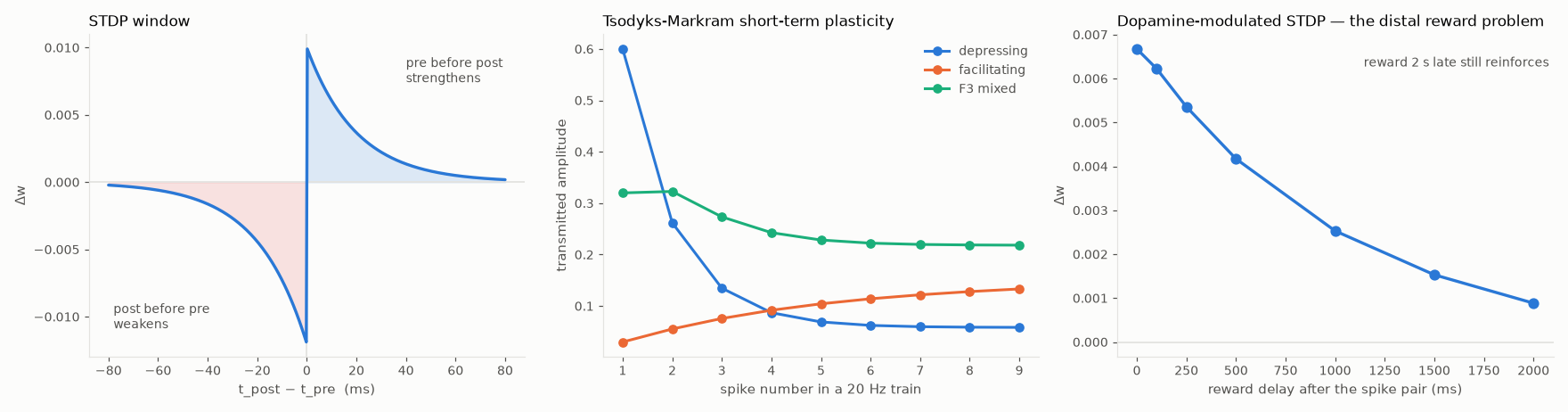
a_minus exceeds a_plus by default. Depression slightly stronger than potentiation is the
standard choice: with symmetric amplitudes, uncorrelated input drives weights upward until they
saturate at w_max.
Traces are read from t-1 deliberately. A pre and post spike within the same timestep are
simultaneous rather than causally ordered, and should not potentiate.
stdp_window
jp.stdp_window(delta_t, *, tau_pre=20.0, tau_post=20.0, a_plus=0.01, a_minus=0.012)
The learning window Δw(Δt), for plotting or for checking parameters against a published
figure. delta_t is post-spike time minus pre-spike time, so positive values are causal.
import jax.numpy as jnp

delta_t = jnp.linspace(-100.0, 100.0, 401)
dw = jp.stdp_window(delta_t, tau_pre=20.0, tau_post=20.0)
TsodyksMarkram
Short-term plasticity: depression and facilitation acting on transmission over hundreds of milliseconds, without changing the underlying weight.
jp.TsodyksMarkram(U=0.6, tau_d=800.0, tau_f=0.0, *, dt=1.0)
| Argument | Meaning |
|---|---|
U | Baseline release probability. |
tau_d | Recovery constant of the depleted resource pool. |
tau_f | Facilitation constant. 0.0 disables facilitation, giving pure depression. |
TsodyksMarkram follows the ordinary state contract, so it drops into a Sequential between a
neuron and the layer it drives:
state = rule.init_state(input_shape)
state, transmitted = rule(state, spikes)
Presets from the Markram characterization are available in jp.MARKRAM_PRESETS as
(U, tau_d, tau_f) tuples:
jp.TsodyksMarkram(*jp.MARKRAM_PRESETS["depressing"])
| Preset | Behaviour |
|---|---|
depressing | Successive spikes transmit progressively less. |
facilitating | Successive spikes transmit progressively more. |
F1_facilitating, F2_depressing, F3_mixed | The three cortical classes as characterized. |
DopamineSTDP
Reward-modulated STDP: a three-factor rule where the coincidence of pre and post spikes leaves a slowly decaying eligibility trace, and weight change occurs only when dopamine arrives.
jp.DopamineSTDP(*, tau_pre=20.0, tau_post=20.0, tau_c=1000.0, tau_dopamine=200.0,
                a_plus=0.01, a_minus=0.0105, dopamine_per_reward=0.005,
                w_min=0.0, w_max=1.0, dt=1.0)
| Argument | Meaning |
|---|---|
tau_c | Decay of the eligibility trace — how long a spike pair remains creditable. |
tau_dopamine | Decay of the dopamine signal itself. |
dopamine_per_reward | Dopamine released per unit of reward. |
rule = jp.DopamineSTDP(tau_c=1000.0)

# reward is (T,): the signal delivered at each timestep.
weight, state = rule(weight, pre_spikes, post_spikes, reward)
tau_c is what solves the distal reward problem: a reward arriving a second after the spike
pair that earned it still finds the eligibility trace alive, so credit reaches the correct
synapse.
State objects
Each rule carries its traces in an explicit state object, returned as the second element of a call and accepted back to continue across chunks. They are ordinary pytrees.
| type | carried by | holds |
|---|---|---|
STDPState | STDP | pre- and postsynaptic eligibility traces |
DopamineState | DopamineSTDP | the STDP traces, the slow eligibility trace, and dopamine |
MarkramState | TsodyksMarkram | the resource pool and the release probability |
state = rule.init_state(batch, n_pre, n_post)     # STDP and DopamineSTDP
state = rule.init_state(input_shape)              # TsodyksMarkram
See also
- Plasticity guide — worked examples and when to reach for each rule
- Online learning — e-prop, for task-driven local learning